Every month it is the same routine. You have a bank reconciliation to post: the fees and interest...
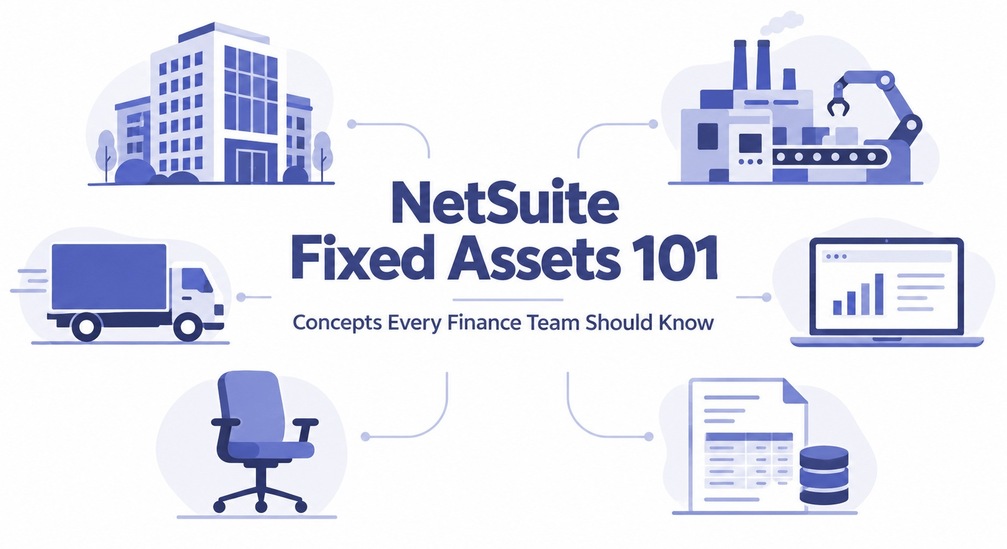
In capital-intensive businesses, fixed assets are often one of the largest lines on the balance sheet, yet many NetSuite customers still track them in spreadsheets that live outside the ERP. Before you configure the NetSuite Fixed Assets Management (FAM) SuiteApp, your finance and systems teams need a shared vocabulary: what a fixed asset is, how it moves through its life, and how every event in that life lands on the financial statements.
This guide covers those concepts in plain language, with worked examples, and shows how each one maps to a feature in NetSuite FAM. It is Part 1 of our 12-part NetSuite Fixed Assets series. When you are ready to put FAM in place, we can help with NetSuite implementation and ongoing support.
In this guide:
Key Takeaways: NetSuite Fixed Assets Basics
- A fixed asset is used in operations for more than a year and is not held for sale. It sits under PP&E at cost less accumulated depreciation.
- Every asset can move through the same lifecycle stages: acquisition, capitalization, depreciation, transfer or split, revaluation, impairment and disposal. Most assets are never revalued or impaired.
- Depreciation follows the matching principle: cost is spread over the years the asset helps earn revenue.
- IFRS and US GAAP differ on revaluation, component depreciation and impairment reversals, which shapes your NetSuite setup.
- NetSuite Fixed Assets Management connects every lifecycle event to the general ledger and replaces spreadsheet registers.
What Is a Fixed Asset?
A fixed asset is a resource a business owns and uses to run its operations and generate income over more than one year. It is not held for sale to customers, and it is not expected to turn into cash within the year.
Fixed assets can be tangible or intangible:
- Tangible: land, buildings, machinery, vehicles, IT equipment, furniture and fixtures, leasehold improvements.
- Intangible: patents, software licenses, copyrights and other intellectual property (often amortized rather than depreciated, but tracked the same way in NetSuite).
On the balance sheet, tangible fixed assets usually sit under Property, Plant and Equipment (PP&E), reported at cost less accumulated depreciation. That net figure is the asset's net book value (NBV).
Capitalize or Expense?
Not every purchase becomes a fixed asset. Companies set a capitalization policy that decides what goes on the balance sheet and what is expensed immediately. A typical policy covers:
- A dollar threshold. Items below it are expensed. Many US companies align with the IRS de minimis safe harbor amounts of $2,500 or $5,000 per item. That safe harbor is a tax election; your book capitalization threshold is a separate accounting policy decision, so confirm both with your auditors and tax advisors.
- A minimum useful life, usually more than one year.
- Rules for bundles, such as whether 20 laptops at $1,200 each are 20 assets, one asset with a quantity of 20, or an expense.
- What counts as an improvement (capitalized) versus a repair (expensed).
Write this policy down before you implement FAM. It drives which GL accounts are flagged as fixed asset accounts, and therefore which purchases NetSuite proposes as new assets.
Why Lenders and Investors Care
Fixed assets are among the first things banks and investors examine. They show a company's operating capacity, and they often serve as collateral. A clean, auditable fixed asset register directly affects how much a company can borrow and on what terms. A register that does not tie to the general ledger raises questions in due diligence and audits alike.
What Is the Fixed Asset Lifecycle?
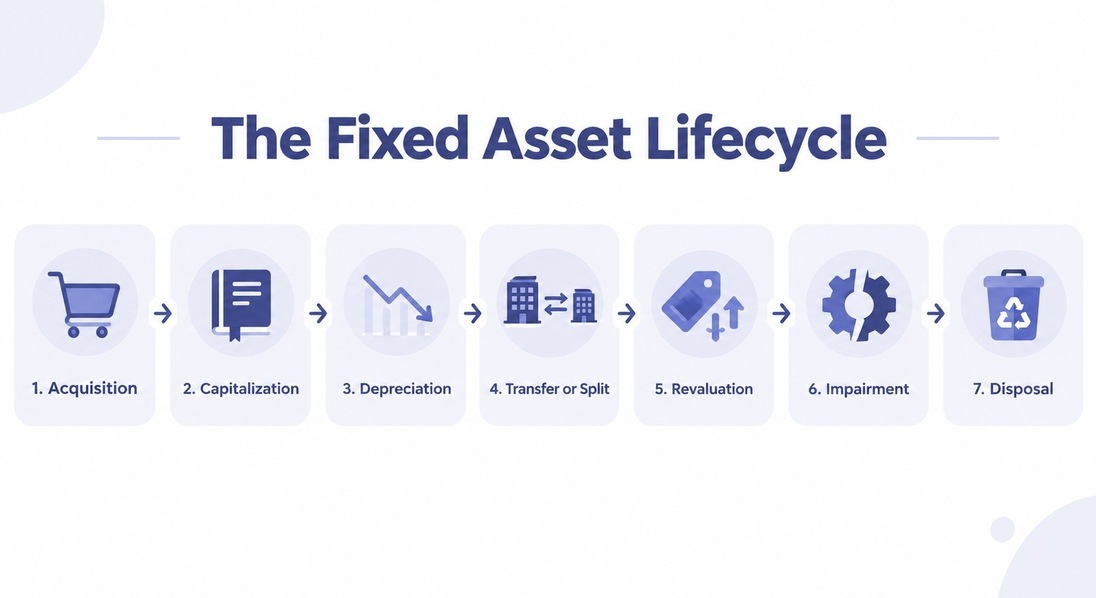
Fixed assets can move through the same broad stages, and each stage an asset goes through creates a transaction that has to be recorded. Most assets are never revalued or impaired.
- Acquisition. The asset is bought outright or leased. A purchase capitalizes the cost; a lease creates a right-of-use asset and a lease liability under ASC 842 and IFRS 16.
- Capitalization. The cost, in-service date, useful life and depreciation method are recorded, and the asset is placed in service.
- Depreciation. The cost is spread over the useful life, usually monthly, using a method such as straight-line or declining balance.
- Transfer or split. The asset moves to another department, location or legal entity, or a group of identical units is broken into separate records.
- Revaluation. Under the IFRS revaluation model, the carrying value is adjusted when fair value differs materially from book value. US GAAP does not allow revaluation.
- Impairment. A sudden loss in value is recognized after a trigger event, such as damage or obsolescence.
- Disposal. The asset is sold, scrapped or retired, and any gain or loss is recognized.
Revaluation vs. Impairment: A Simple Example
A company buys a $20,000 device and depreciates it at $2,000 per year. After two years, book value is $16,000. Market research shows an identical used device now sells for $12,000.
Under IFRS, a company that uses the revaluation model can bring the books to $12,000, and future depreciation runs on the new figure. IAS 16 requires the whole class of similar assets to be revalued, regularly enough that carrying values stay close to fair value, not one device at a time. Under US GAAP, revaluation is not allowed. The price drop is only a possible impairment indicator, which triggers a recoverability test. The device still works; its price changed.
Impairment is different. Suppose a new platform launches that the device cannot support, and the business can no longer use it for the work it was bought for. The device has lost its ability to generate value, not just its market price. That loss is recorded as an impairment.
How Do Fixed Assets Hit the Financial Statements?
Each lifecycle event lands on a different combination of statements.
| Event | Balance sheet | Income statement | Cash flow statement |
|---|---|---|---|
| Acquisition (purchase) | Asset recorded at cost under PP&E | None | Cash outflow in investing activities (capex) |
| Acquisition (lease) | Right-of-use asset and lease liability | Finance leases (and all leases under IFRS 16): interest plus amortization. ASC 842 operating leases: a single straight-line lease cost | Lease payments, classified by lease type |
| Depreciation | Accumulated depreciation reduces NBV | Depreciation expense | None (non-cash, added back in operating activities) |
| Revaluation gain (IFRS) | Carrying value increases | OCI, not profit or loss (revaluation surplus) | None |
| Revaluation loss or impairment | Carrying value decreases | Loss in the period. Under IFRS, a revaluation decrease first reduces any existing revaluation surplus in OCI | None |
| Disposal | Cost and accumulated depreciation removed | Gain or loss on disposal | Sale proceeds in investing activities |
Revaluation and impairment are non-cash events. Cash only moves when the asset is bought, leased or sold.
How Do IFRS and US GAAP Differ?
If your group reports under more than one framework, these differences shape how you configure NetSuite.
| Topic | IFRS (IAS 16, IAS 36) | US GAAP (ASC 360) |
|---|---|---|
| Measurement after acquisition | Cost model or revaluation model | Cost model only |
| Upward revaluation | Allowed under the revaluation model | Not allowed |
| Component depreciation | Significant parts depreciated separately | Permitted but less common |
| Reversal of impairment | Allowed (except goodwill) | Not allowed for assets held and used |
In practice, a US parent with IFRS or local GAAP subsidiaries often needs separate depreciation books. NetSuite handles this with alternate methods and Multi-Book Accounting, covered in Part 4 of this series.
Still tracking fixed assets in a spreadsheet? Our free NetSuite Fixed Assets Health Check reviews your register and shows how FAM would fit. Book your health check
Why Does Depreciation Matter?
Depreciation allocates an asset's cost over its useful life. Each period, a portion moves from the balance sheet to the income statement as depreciation expense, until net book value reaches the residual value.
The reason is the matching principle: expenses belong in the same periods as the revenue they help generate. A $900,000 production line with a nine-year life supports revenue for nine years, so its cost is spread across those nine years instead of hitting profit all at once in year one.
Key Terms
| Term | Meaning |
|---|---|
| Original cost | What the business paid to acquire the asset and get it ready for use |
| Useful life | How long the asset is expected to produce value, in years or periods |
| Residual (salvage) value | What the asset is expected to be worth at the end of its life |
| Depreciable amount | Cost minus residual value |
| Accumulated depreciation | Total depreciation recorded to date, held in a contra-asset account |
| Net book value (NBV) | Cost minus accumulated depreciation (and any write-downs) |
Worked Example: Straight-Line vs. Declining Balance
A company buys equipment for $10,000 with a five-year life and no residual value. Here is how two common methods compare.
| Year | Straight-line expense | Straight-line NBV | Double declining expense | Double declining NBV |
|---|---|---|---|---|
| 1 | $2,000 | $8,000 | $4,000 | $6,000 |
| 2 | $2,000 | $6,000 | $2,400 | $3,600 |
| 3 | $2,000 | $4,000 | $1,440 | $2,160 |
| 4 | $2,000 | $2,000 | $864 | $1,296 |
| 5 | $2,000 | $0 | $1,296 | $0 |
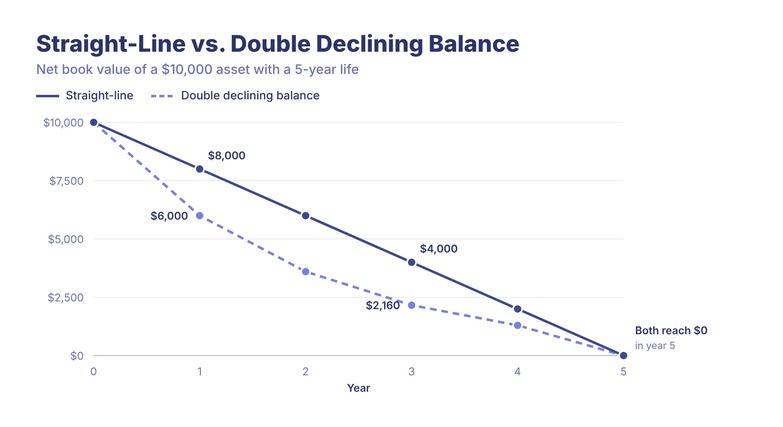
Both methods expense the full $10,000 over five years. Straight-line spreads it evenly. Double declining balance charges 40% of the remaining balance each year, front-loading the expense, and the final year picks up whatever is left. Strict 40% math in year 5 would charge only $518 and leave $778 on the books, so the table follows NetSuite's default Fully Depreciate convention, which adds that remaining $778 to the final period ($518 + $778 = $1,296). That is why year 5 is higher than year 4. Many companies instead switch to straight-line once it gives the higher charge (here, from year 4: $1,080 a year), which spreads the remainder more evenly. In NetSuite, this last-period behavior is controlled by the Final Period Convention, which Part 3 explains.
Which method is right depends on how the asset actually loses value, what your accounting policy says, and what tax rules require. Many companies use straight-line for the books and an accelerated method for tax, which is exactly why NetSuite supports more than one depreciation schedule per asset.
Why Do Spreadsheets Stop Working?
A spreadsheet register works for a handful of assets. It breaks down as the business grows:
- No link to the GL. Every depreciation entry is keyed by hand, so the register and the ledger drift apart.
- Version control. Several copies circulate, and nobody is sure which one the auditors saw.
- Formula errors. One broken formula can misstate depreciation for years before anyone notices.
- Multi-entity complexity. Different subsidiaries, currencies and tax books multiply the tabs.
- Weak audit trail. There is no easy way to trace an asset back to the vendor bill that created it.
This is the gap NetSuite Fixed Assets Management fills.
How Does NetSuite FAM Map to the Lifecycle?
FAM is a SuiteApp that installs into your NetSuite account and connects every lifecycle event to the general ledger. Here is where each concept lives, and where this series covers it.
| Lifecycle stage | NetSuite FAM feature | Covered in |
|---|---|---|
| Policy and structure | Chart of accounts, asset types, FAM preferences | Part 2 |
| Depreciation rules | Depreciation methods and formulas | Part 3 |
| Tax and statutory books | Alternate methods, Multi-Book Accounting | Part 4 |
| Acquisition | Asset Proposal, Asset Creation, manual entry, compound assets | Part 5 |
| Go-live | CSV import of mid-life assets and depreciation history | Part 6 |
| Depreciation | Asset Depreciation run at period end | Part 7 |
| Revaluation and impairment | Asset Revaluation | Part 8 |
| Disposal | Asset Disposal by sale or write-off | Part 9 |
| Transfers and splits | Asset Transfer, Asset Split | Part 10 |
| Leases | Lease Accounting for ASC 842 and IFRS 16 | Part 11 |
| Reporting and audit | Asset register, summary and depreciation reports | Part 12 |
Analyzing Fixed Asset Data in Excel and Google Sheets
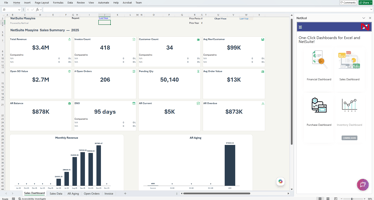
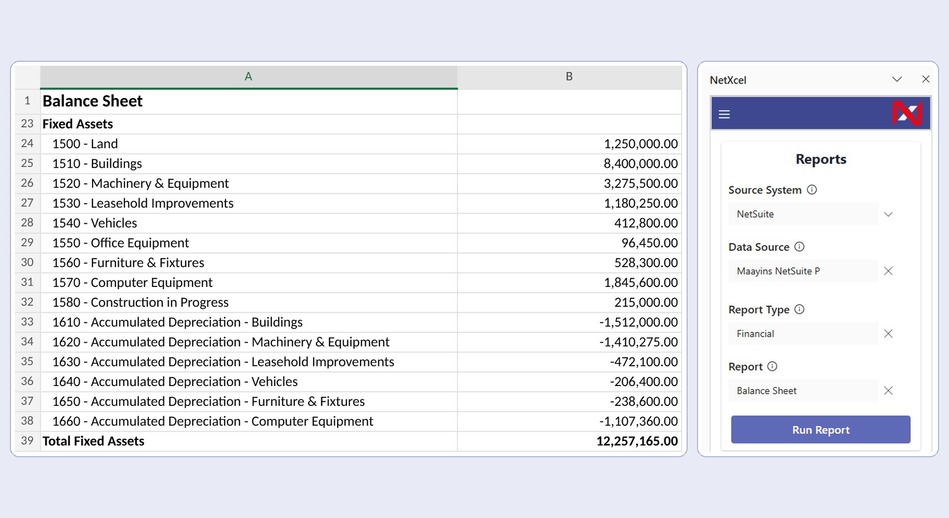
Even with FAM in place, finance teams still review the numbers in a spreadsheet: tying the asset register to the balance sheet, explaining swings in depreciation, or preparing a capex summary for the board. NetXcel, a free add-in for Excel and Google Sheets, pulls live NetSuite reports such as the balance sheet and trial balance straight into your workbook, so the spreadsheet becomes a view of the ERP instead of a separate copy of it.
Frequently Asked Questions
What is the difference between a fixed asset and a current asset?
A current asset, such as inventory or receivables, is expected to be used or turned into cash within a year. A fixed asset is used in operations over several years and is not held for sale.
Is land depreciated?
No. Land has an unlimited useful life, so it is carried at cost. Buildings on the land are depreciated separately.
What is the difference between depreciation and amortization?
Both spread a cost over time. Depreciation is the term for tangible assets; amortization is used for intangible assets such as patents and software licenses, and for right-of-use assets from leases.
Do I need NetSuite FAM, or can I record depreciation with journal entries?
You can post manual journals, but you lose the asset-level detail, automatic schedules and audit trail. Once a company has more than a few dozen assets, or more than one entity, FAM usually pays for itself in time saved at close and audit.
Start with a NetSuite Fixed Assets Health Check
We help companies implement, clean up and optimize NetSuite Fixed Assets Management, from capitalization policy and depreciation design to multi-book tax setup, asset migration and ongoing managed services. Our free Fixed Assets Health Check reviews your current register, setup and close process and gives you a clear plan.